
How to Create a Monthly Household Budget
A monthly household budget should give you a clear view of the money you have coming in and what you are spending. It should let you quickly and simply understand where your money is going, and help you make better decisions to achieve your financial goals. You do not need a complicated spreadsheet to create one.
This guide takes you through the process step by step so you can build a budget that reflects your household and is easy to keep up to date.
What is a monthly household budget?
A household budget brings together the money you receive and the money you plan to spend in a single monthly view. It is a practical way to see the whole picture rather than tracking each bill in isolation. A typical monthly budget covers:
- Monthly income
- Essential bills
- Everyday spending
- Debt repayments
- Savings
- Irregular or annual costs
- The amount remaining after planned spending
A good budget does not need to be complicated. It simply needs to be accurate enough to be useful and simple enough that you will keep it up to date.
Start with your monthly income
List the income that is actually available to spend each month after deductions. Common sources include:
- Employment income
- Self-employment income
- Pension income
- Benefits
- Maintenance payments
- Regular household contributions
- Other regular income
If your income varies from month to month, it is often safer to budget using a cautious or lower monthly estimate. That way an average month will comfortably cover your planned costs.
Use take-home income rather than gross salary when building your household budget.
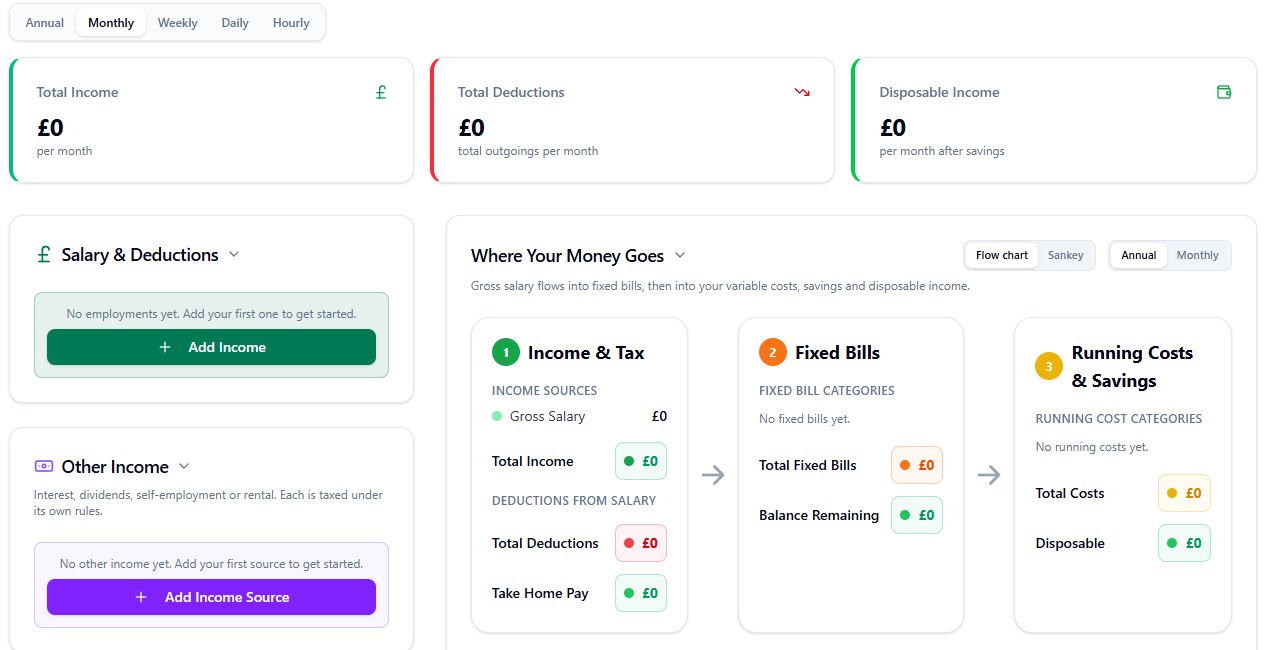
If you are not sure what your monthly take-home pay will be, calculate your monthly take-home pay for free with My Simple Salary. If you are using My Simple Budget, the tool will work this out for you as part of the budget.
List your essential household bills
Essential bills are the regular costs your household needs to cover each month. These are often taken by direct debit so are easy to spot on a bank statement. Recording these before flexible spending gives you a realistic picture of what spending money is genuinely available to you each month.
- Rent or mortgage
- Council Tax
- Gas and electricity
- Water
- Insurance policies
- Broadband
- Mobile phone
- Childcare
- Transport needed for work
- Minimum debt repayments
Add everyday spending
Everyday spending covers the day-to-day costs of running your household. Common categories include:
- Groceries
- Fuel
- Public transport
- Eating out
- Clothing
- Entertainment
- Subscriptions
- Children’s activities
- Personal care
- General household purchases
Everyday spending is the section people most often underestimate. Reviewing the last two or three months of bank and card statements gives you a much more accurate figure than guessing. If you are using My Simple Budget, its built-in AI tool can analyse a bank-statement export and categorise your spending for you.
Include annual and irregular costs
Costs do not need to occur every month to belong in a monthly budget. Leaving them out is one of the main reasons a budget stops working part way through the year. Typical examples include:
- Car insurance
- Car servicing and repairs
- MOT
- Birthdays
- Christmas
- Holidays
- School costs
- Home maintenance
- Professional fees
- Annual subscriptions
A simple approach is to divide the expected annual cost by 12 and include that amount each month.
If car insurance costs £600 per year, setting aside £50 per month means the cost is gradually included in the budget.
Decide how much to allocate to savings
Savings should be based on what is realistically affordable after your essential costs have been covered. A smaller amount saved consistently is often more sustainable than an ambitious target that quickly becomes unaffordable. Common savings purposes include:
- Emergency savings
- Annual bills
- Holidays
- Home improvements
- A car
- Longer-term goals
There is no single percentage that suits every household. Start with an amount you can genuinely commit to and adjust it as your circumstances change. Even just £15 per week can become a meaningful amount over the course of a few years of persistent, committed saving.
Work out what remains
Once your income and planned spending are in place, the calculation is straightforward:
Monthly income − Planned monthly spending = Amount remaining
The result can tell you several useful things:
- Money available for additional saving
- Money available for flexible spending
- A need to reduce or reconsider certain costs
- A need to revisit the income estimate
- Costs that may have been missed
Worked monthly budget example
The example below shows how a fictional UK household might set out a monthly budget. It is illustrative only and not a recommended budget for every household.
| Category | Monthly amount |
|---|---|
| Household take-home income | £3,200 |
| Housing and household bills | £1,400 |
| Groceries and transport | £650 |
| Other regular spending | £400 |
| Savings and annual-cost funds | £350 |
| Remaining amount | £400 |
In this example, the remaining £400 could be divided between flexible spending, additional savings and a buffer for unexpected costs. What matters is deciding in advance rather than letting the balance drift.
Common budgeting mistakes
Too often, after making a budget, the next few months go by and the balance in your bank seems to keep going down despite the promising numbers in your spreadsheet. This is very common, as there are a number of easy-to-make mistakes when it comes to budgeting. Being aware of them makes them easier to avoid:
- Using gross salary instead of take-home pay — a simple mistake, but failing to account for tax, National Insurance, student loan repayments and pension contributions can leave you wondering where a large part of your budget has gone.
- Forgetting annual costs — car servicing, boiler repairs and new tyres do not come around regularly, but they can make a serious dent in your finances when they do. Forgetting annual or irregular costs can leave your budget looking healthier than it really is, potentially leaving you short or requiring you to use credit when the bill arrives.
- Underestimating groceries and everyday spending — the cost of food and household items is often the largest variable cost in a household budget. Remember to include less predictable purchases too, such as ordering a takeaway on a busy evening.
- Leaving out small subscriptions — individually £5 here and £9.99 there might not seem like much, but month on month they can become a meaningful part of your total spending.
- Setting an unrealistic savings target — if your savings goals are too high, it can leave you with nothing to spend on yourself, making the budget feel frustrating and hard to stick to.
- Failing to update the budget after circumstances change — review your budget whenever your income, household costs or personal circumstances change, otherwise it will quickly stop giving you useful insights and your hard-earned savings can be drained away.
- Treating every remaining pound as available to spend — no budget is perfect, so even a healthy-looking budget can be knocked off course by unforeseen costs. Spending close to the limit can put strain on your finances.
A simpler alternative to a budgeting spreadsheet
Spreadsheets can work well, but they can also become difficult to set up, maintain and interpret. My Simple Budget guides you through your income and spending step by step, helping you build a clearer picture of your monthly finances without creating formulas or managing a complex spreadsheet.
If a spreadsheet already works for you, there is no need to change. The best budgeting method is the one you will actually keep using.
Ready to build your own monthly budget?
Enter your income and regular spending into My Simple Budget to see where your money is going and what you may have left after planned costs.
Frequently asked questions
What should be included in a monthly household budget?
A monthly household budget should include your income, essential bills, everyday spending, savings, debt repayments and a monthly allowance for annual or irregular costs.
Should I use gross salary or take-home pay?
A household budget should generally use the amount actually received after tax, National Insurance, pension and other deductions.
How do I budget for annual bills?
Divide the expected annual amount by 12 and include it as a monthly saving or cost so the money is set aside gradually.
How often should I update my budget?
Review your budget whenever income, bills or household circumstances change, and otherwise check it regularly to keep it accurate.
Do I need a spreadsheet to make a household budget?
A spreadsheet is optional. You can use a budgeting tool, app, notebook or any other method you can maintain consistently.
About My Simple Apps
My Simple Apps creates practical tools designed to make everyday decisions easier. Its finance tools are informed by five years of practical experience working in tax and accounts, with a focus on clear and accessible information.
This guide provides general information only and does not constitute personal financial, tax or debt advice. Figures produced by the tools are estimates based on the information entered.